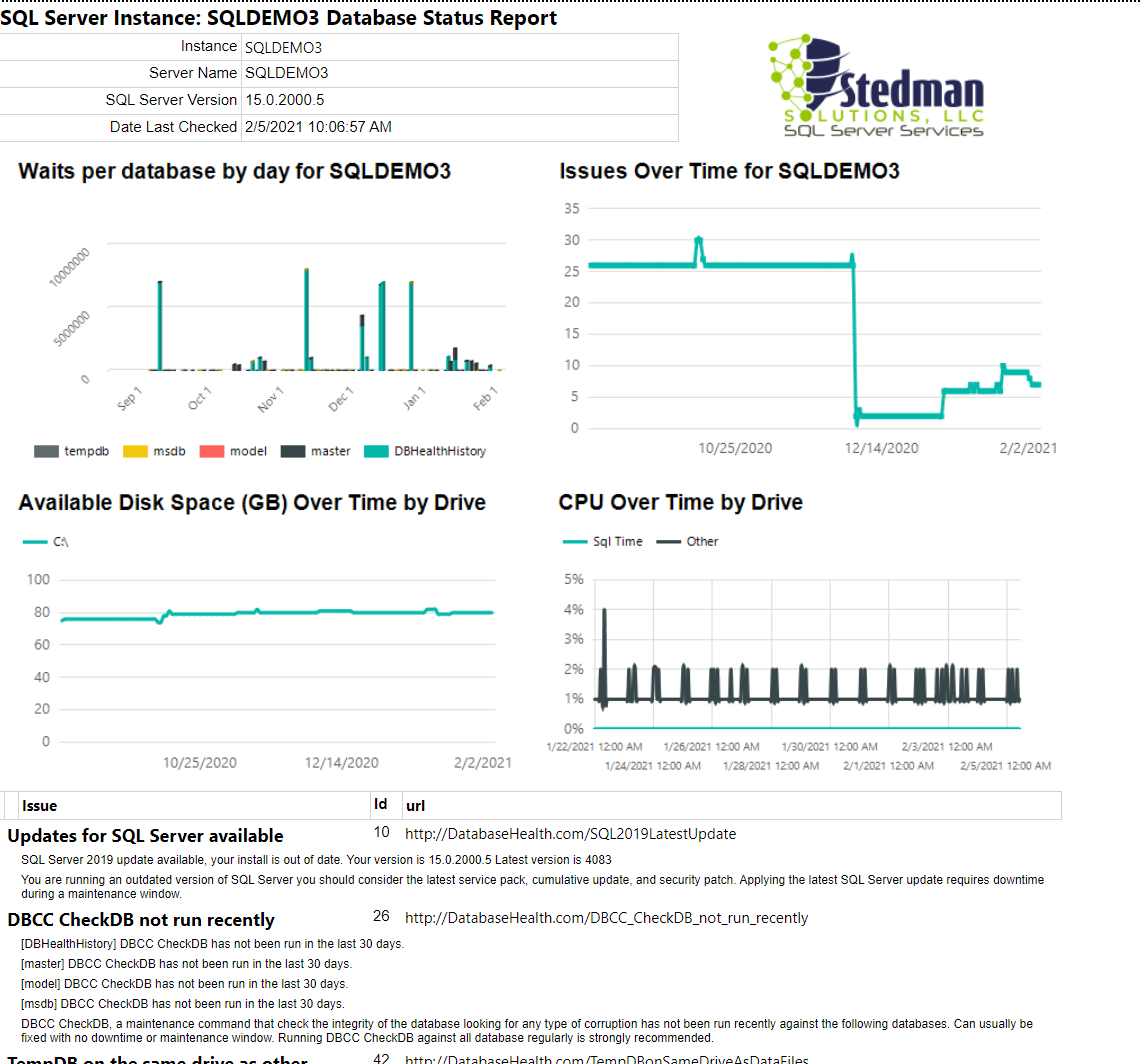
Stedman Solutions Daily Monitoring Product
A great way to keep tabs on the overall health of your SQL Server. Pricing: $129.99 per month per SQL Server instance when paid month… Read More »Stedman Solutions Daily Monitoring Product
Blog posts relating to SQL Performance Tuning.
SQL Server tuning is the process of optimizing the database’s configuration, queries, and infrastructure to ensure the system runs as efficiently as possible. The goal is to reduce resource usage, increase query speed, and improve overall system responsiveness. Performance tuning involves analyzing server performance metrics, identifying bottlenecks, and implementing solutions that range from hardware upgrades to query rewriting. These optimizations are crucial for maintaining a smooth user experience and supporting business-critical applications.
A key aspect of performance tuning is query optimization. Poorly written SQL queries, missing indexes, or incorrect indexing strategies often lead to slow query execution. By using tools such as execution plans and SQL Profiler, DBAs can identify and correct inefficiencies in SQL code. Techniques like index tuning, query rewriting, and partitioning can drastically reduce query execution times. Regularly updating statistics and reorganizing or rebuilding indexes further enhances query performance and ensures accurate query plans.
Beyond queries, performance tuning also focuses on the SQL Server environment itself. Configuring server settings, adjusting memory allocation, and fine-tuning I/O operations play a significant role in optimizing database performance. Monitoring tools like Database Health Monitor (available at DatabaseHealth.com) provide insights into server health and potential issues. Stedman Solutions offers comprehensive SQL Server performance tuning services, combining years of experience with specialized tools to ensure your SQL Server environment performs at its peak. Learn more about our managed services at Stedman Solutions.
A great way to keep tabs on the overall health of your SQL Server. Pricing: $129.99 per month per SQL Server instance when paid month… Read More »Stedman Solutions Daily Monitoring Product

Welcome to April at Stedman Solutions, LLC! This month, we’re excited to announce that April is JOINS month, where all our promotions and activities will… Read More »April Promo Join Types Poster

Monitoring backups is an essential part of database administration, as it ensures that you have reliable and up-to-date backups in case of data loss or… Read More »Database Health: Monitoring Backups with Database Health Monitor

Welcome to April at Stedman Solutions, LLC! This month, we’re excited to announce that April is JOINS month, where all our promotions and activities will… Read More »My Join Types Course

Welcome to April at Stedman Solutions, LLC! This month, we’re excited to announce that April is JOINS month, where all our promotions and activities will… Read More »Join Types Shirt
DBCC CLONEDATABASE is a DBCC command in Microsoft SQL Server that can be used to create a copy of a database on the same server.… Read More »SQL Server DBCC Commands: DBCC CLONEDATABASE

Welcome to April at Stedman Solutions, LLC! This month, we’re excited to announce that April is JOINS month, where all our promotions and activities will… Read More »Join Types on your wall
In the world of SQL Server management, ensuring database integrity is a cornerstone of reliable and efficient operations. Database integrity refers to the accuracy, consistency,… Read More »SQL Server Database Integrity: Importance and Corruption Prevention Tips
Welcome to April at Stedman Solutions, LLC! This month, we’re excited to announce that April is JOINS month, where all our promotions and activities will… Read More »Don’t Miss Out With Join Types Month

In today’s fast-paced business landscape, data is the backbone of decision-making and operational efficiency. As a business leader or IT professional, you rely heavily on… Read More »Why SQL Server Managed Services Are Essential for Your Business Success