Skip to content

Database Corruption Challenge #8 has Ended

With many participants and 16 who correctly solved Corruption Challenge week 8, the challenge has come to an end. The overall winner was Rob Farley, and there were several new participants this week. The scores page has been updated.

Some participants called this the toughest challenge yet which makes my job even harder to come up with something more challenging for next time.  There were a couple interesting twists in this one. One was the way the corruption caused issues with DBCC Page. On SQL Server 2014 DBCC Page on the corrupt page with the output parameter of 3 didn’t work, and the only output option that worked was option 2. However on SQL Server 2008R2 and 2012, none of the DBCC Page output options worked on the corrupt page, which forced some to open the database file with a hex editor to pull the data in from the corrupt page.

The one thing that I didn’t judge anyone badly with was the capitalization of the person in the corrupt record.  I accepted EMMA, E WILLIAMS, and Emma, E Williams, and Emma, E WILLIAMS all as correct answers, as to figure out any of those it took the same amount of work.

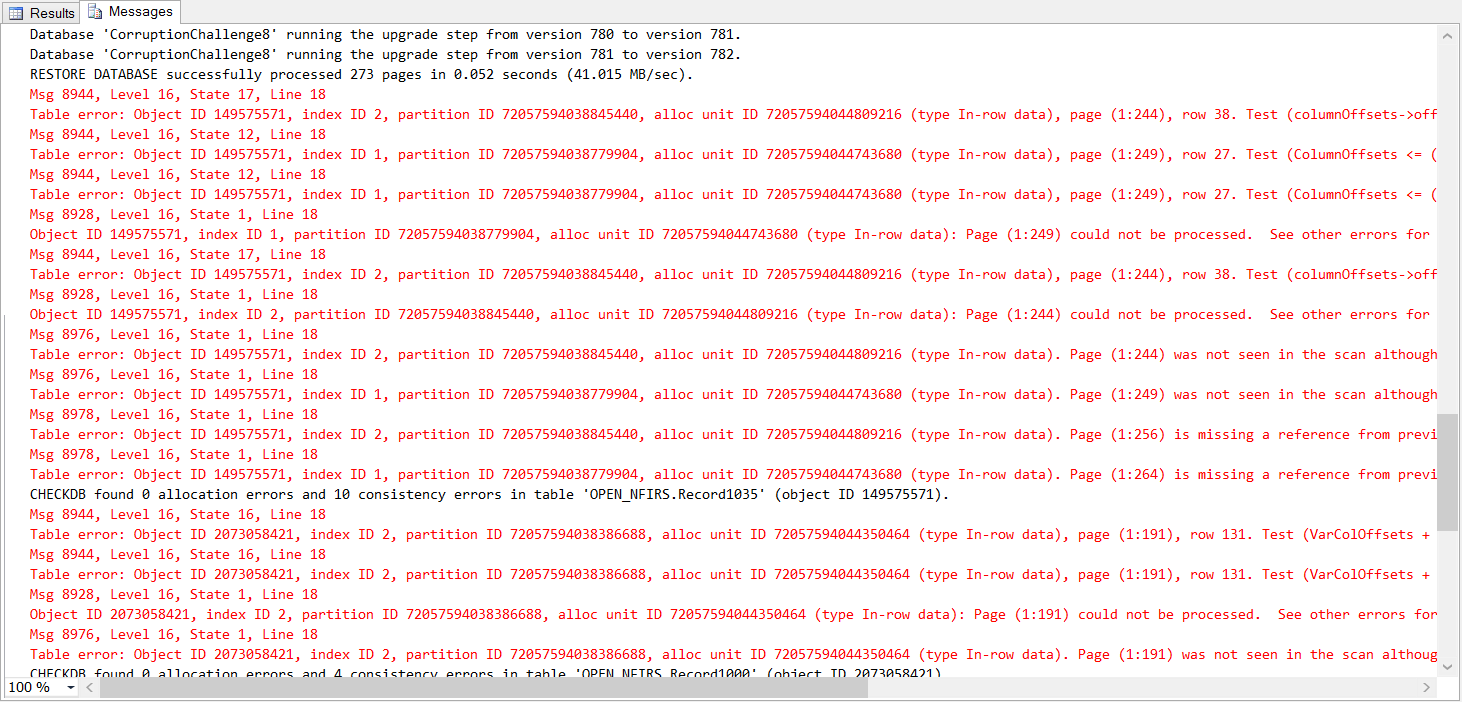
The solution by Rob Farley:
Read More »Database Corruption Challenge #8 has Ended

Corruption Challenge #8

Welcome to the eighth week of 10 in the Database Corruption Challenge (DBCC), this is an about weekly competition. Here is how it works; I have created a corrupt database, hopefully more corrupt or more interesting than the previous week. I then solved the corruption myself in order to prove that it is possible to fix, without data loss. There is a total of 4 points available to be earned this week.

  • 1 point extra for being the first correct answer. Already taken by Rob Farley.
  • 1 point to all who get the correct answer.
  • 1 point extra if you get the correct answer before any hints are given.
  • 1 point extra if your solution is correct the first time you submit it to me.  (check your work)

Week8

Corruption Challenge General Info

The challenge will be to download the corrupt or somehow damaged database and attempt to recover it. If you can recover it, please send me the steps you used to recover the database, along with some proof that the database has been recovered. The goal each week will be the following:

Read More »Corruption Challenge #8

Database Corruption – the first 7 weeks

Lately several people have asked me for the solutions to the corruption challenge, so I thought it would be a good time to recap the last 7 weeks.

Week4Winner1

Read More »Database Corruption – the first 7 weeks

When Database Corruption Strikes

Today I am presenting to the session “When Database Corruption Strikes” to the High Availability and Disaster Recovery PASS Virtual Chapter.

Presentation

Here is the abstract:

You are working along month after month with no problems in your database. Suddenly someone reports that their query won’t run. They get an error stating “SQL Server detected a logical consistency-based I/O error“, or something even scarier. Do you know what to do now? We will walk through 3 or 4 actual corrupt databases exploring ways to go about finding and fixing the corruption. More importantly we will explore how to prevent further data loss at the time corruption occurs. Learn what things you should do to protect yourself when corruption strikes. Learn what to avoid that will make things worse. You will leave with a checklist of steps to take when you encounter corruption. By the end of this session you will be ready to take on corruption, one database at a time

Read More »When Database Corruption Strikes

Database Corruption Challenge Week 7 – Alternate Solution

The alternate solution to the Database Corruption Challenge this week was created by Patrick Flynn. This solution is the only solution to successfully recover all the data without using any of the backups. If the challenge had been structured differently and all you had was just the database files and no backups, this solution would work just fine.

As you read through this solution, you will notice the use of Common Table Expressions throughout the solution. Patrick is the first person that I have seen write TSQL code that uses Common Table Expressions more than I do. (I mean that as a compliment Patrick)

To start with let’s add the UDF_Convert_Hex_to_Binary function into the master database to match what Patrick had in his system.

All code provided by Patrick, comments and screenshots by me.

-- Step 0 - Create Supporting function
USE [master]
GO
CREATE FUNCTION [dbo].[UDF_Convert_Hex_to_Binary]
(
      @HEX VARBINARY(MAX)
)
RETURNS VARCHAR(MAX)
BEGIN

	DECLARE @BINARY VARCHAR(MAX)

	;WITH N1 (n) AS (SELECT 1 UNION ALL SELECT 1),
	N2 (n) AS (SELECT 1 FROM N1 AS X, N1 AS Y),
	N3 (n) AS (SELECT 1 FROM N2 AS X, N2 AS Y),
	N4 (n) AS (SELECT ROW_NUMBER() OVER(ORDER BY X.n)
	FROM N3 AS X, N3 AS Y)

	SELECT @BINARY=ISNULL(@BINARY,'')
	+ CONVERT(NVARCHAR(1), (SUBSTRING(@HEX, Nums.n, 1) / 128) % 2)
	+ CONVERT(NVARCHAR(1), (SUBSTRING(@HEX, Nums.n, 1) / 64) % 2)
	+ CONVERT(NVARCHAR(1), (SUBSTRING(@HEX, Nums.n, 1) / 32) % 2)
	+ CONVERT(NVARCHAR(1), (SUBSTRING(@HEX, Nums.n, 1) / 16) % 2)
	+ CONVERT(NVARCHAR(1), (SUBSTRING(@HEX, Nums.n, 1) / 8) % 2)
	+ CONVERT(NVARCHAR(1), (SUBSTRING(@HEX, Nums.n, 1) / 4) % 2)
	+ CONVERT(NVARCHAR(1), (SUBSTRING(@HEX, Nums.n, 1) / 2) % 2)
	+ CONVERT(NVARCHAR(1), SUBSTRING(@HEX, Nums.n, 1) % 2) 

	FROM N4 Nums
	WHERE Nums.n<=LEN(@HEX) 

	RETURN @BINARY
END
GO

Once that function is created, let’s drop the previous CorruptionChallenge7 database, because this is probably not our first time running through the solution. If you have a different way of checking for a database and dropping it, please see my blog post related to this topic earlier today.

Read More »Database Corruption Challenge Week 7 – Alternate Solution