Transact SQL OVER Clause – ROWS UNBOUNDED PRECEDING or FOLLOWING

In a previous article I covered the usage of ROWS PRECEDING and FOLLOWING in the over clause. For this example I am going to use the same database and tables that I created in the previous example to show ROWS UNBOUNDED both PRECEEDING and FOLLOWING.
One of the new features available in TSQL in SQL Server 2012 is the ROWS UNBOUNDED PRECEDING and the ROWS UNBOUNDED FOLLOWING options. The UNBOUNDED option in available when using the PRECEDING and FOLLOWING options. Here’s how they work…
ROWS UNBOUNDED PRECEDING
-- ROWS UNBOUNDED PRECEDING
select Year, DepartmentID, Revenue,
 min(Revenue) OVER (PARTITION by DepartmentID
 ORDER BY [YEAR]
 ROWS UNBOUNDED PRECEDING) as MinRevenueToDate
from REVENUE
order by departmentID, year;
In this example, the MinRevenueToDate lists the lowest revenue for this row and all earlier rows ordered by date in the current department id.
You can see that row 1 sets the MinRevenueToDate to 10030, and it doesn’t change until row 7 with a lower revenue year.
Then row 16 starts over for a new department with the lowest running revenue to date. Then row 21 resets to a lower revenue number.

ROWS UNBOUNDED FOLLOWING
Now for the example of UNBOUNDED FOLLOWING:
-- ROWS UNBOUNDED FOLLOWING
select Year, DepartmentID, Revenue,
 min(Revenue) OVER (PARTITION by DepartmentID
 ORDER BY [YEAR]
 ROWS BETWEEN CURRENT ROW AND UNBOUNDED FOLLOWING) as MinRevenueBeyond
from REVENUE
order by departmentID, year;
Where you can see that the min(Revenue) is calculated over all of the rows from the current row to the end of the set partitioned by the departmentID.
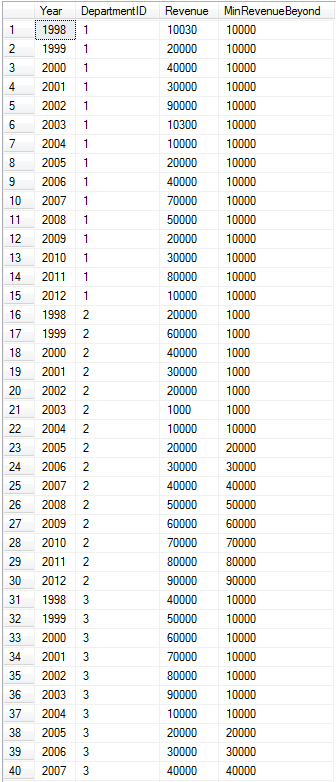
The UNBOUNDED option is very useful to determine a calculation from the beginning of a set to the current row, or from the current row to the end of a set or group.
Keep in mind that this feature was introduced in SQL Server 2012, and is not available in earlier editions.
Related Links
More from Stedman Solutions:

Steve and the team at Stedman Solutions are here for all your SQL Server needs.
Contact us today for your free 30 minute consultation..
We are ready to help!
Hello,
thanks for the Article.
I am wondering if this is a breaking change to SQL 2005, 2008 and 2008 R2. The OVER CLAUSE was possible in all these versions, with aggregation operators like SUM, and acted on ALL rows in the window (which was controlled by a PARTITION BY clause if needed)
As I understand it now with 2012, if I do not specifically put ROWS UNBOUDED in the queries the default behaviour will be UNBOUNDED PRECIDING up to only CURRENT ROW?
This would be a change to the previous behaviour, right?
Thanks for your input on this!
Ralf,
I’ve found that if there is an ORDER BY clause without ROWS UNBOUNDED, the default behaviour is the same as ROWS UNBOUNDED PRECEDING, i.e. up to the current row.
However, if there is no ORDER BY clause, the default behaviour is to use every row defined by the PARTITION BY clause.